Updated: Aug 26
Knowledge Hub › Technical Insights
TECHNICAL INSIGHTS
Understanding the ATP K-Coefficient: What It Tells You About an Insulated Body
A practical engineering explanation of the ATP K-coefficient, what it measures, how it relates to insulation performance and why test conditions and measurement quality matter.
17 August 2026 · Technical Insights · 3 min read
KEY TAKEAWAY
The K-coefficient expresses the overall heat-transfer performance of the insulated body. Lower values indicate better insulation, but the result is meaningful only when the test configuration, conditions and measurements are technically controlled.
IN THIS GUIDE
For insulated equipment used in temperature-controlled transport, thermal performance begins with a simple engineering question: how readily does heat pass through the body? Under the ATP framework, the K-coefficient provides a standardized way to express that overall heat-transfer performance.
What the ATP K-coefficient represents
The K-coefficient is the overall heat-transfer coefficient of the insulated body. In practical terms, it describes the rate of heat transfer through the complete enclosure in relation to the mean heat-transfer surface area and the temperature difference between the inside and outside environments. A lower K-value indicates better overall insulation performance.

Why the value matters under ATP
ATP distinguishes insulated equipment according to thermal insulation performance. Normally insulated equipment is specified by a K-coefficient not exceeding 0.70 W/m²·K, while heavily insulated equipment is specified by a K-coefficient not exceeding 0.40 W/m²·K. The measured K-value therefore contributes directly to equipment classification and to the technical evidence used in the ATP conformity process.
K is a system-level property
The result is not simply a property of the insulation material. The complete body influences heat transfer: wall and roof construction, floor structure, doors, joints, structural bridges, penetrations, seals and assembly details can all affect the measured performance. Two bodies using similar insulation materials can therefore produce different K-values.
K describes the thermal performance of the complete body, including joints, doors, penetrations and thermal bridges—not only the insulation material.
Why test conditions matter
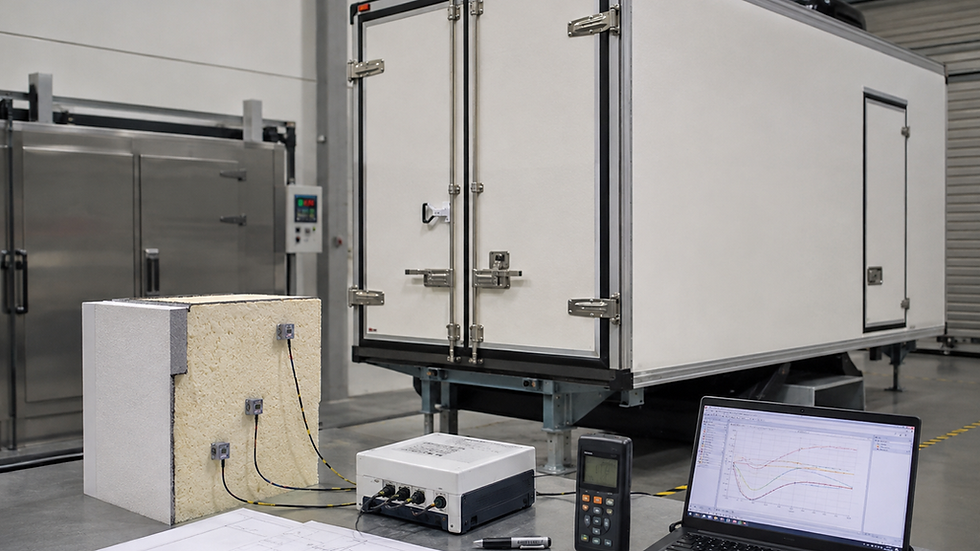
A meaningful K-coefficient requires controlled test conditions and a stable thermal state. Temperature distribution, heat input, air circulation, sensor location, stabilization criteria and the determination of relevant surface areas all influence the quality of the result. The purpose of the test is not merely to generate a number, but to establish technically defensible evidence of the body's overall thermal performance.
A K-value is only as defensible as the thermal stability, sensor placement and test conditions used to determine it.
Measurement quality is part of the result
Instrumentation accuracy, calibration status, traceability, data acquisition and the treatment of measurement uncertainty all contribute to confidence in the reported K-value. When a result is close to a classification limit, measurement quality becomes especially important because small errors or uncontrolled test conditions can affect the technical interpretation.
When a measured K-value approaches a classification limit, measurement quality becomes part of the compliance decision.
Practical engineering takeaway
For manufacturers and technical teams, the K-coefficient should be treated as more than a certification figure. It is a useful engineering indicator of how the complete insulated body performs and where design, assembly or test-quality issues may influence compliance readiness. Reviewing the body design and the planned measurement approach before formal testing can reduce avoidable uncertainty later in the process.
Primary reference
The primary technical reference is the UNECE ATP Agreement and its annexes, together with the ATP Handbook where explanatory comments are provided. Applicable requirements and competent-authority procedures should always be checked against the current official text.
ATP Compliance is an independent technical information and advisory platform and is not affiliated with UNECE, national competent authorities or official ATP test stations.
Related Technical Guides
Need technical guidance?
ATP Compliance provides independent engineering guidance on ATP requirements, testing strategy, measurement quality and compliance readiness.
Comments