Updated: Aug 26
Knowledge Hub › ATP Updates
ATP UPDATES
ATP 2026 Amendments: What Changes on 25 August 2026?
A practical engineering review of the ATP amendments entering into force on 25 August 2026, with a focus on what manufacturers, operators and technical teams should check now.
17 August 2026 · ATP Updates · 4 min read

KEY TAKEAWAY
The 25 August 2026 amendments are more than a document update: technical teams should review equipment definitions, test evidence, measurement requirements and compliance-readiness workflows against the revised ATP framework.
IN THIS GUIDE
The ATP 2026 amendments enter into force on 25 August 2026, introducing a new set of changes to the Agreement on the International Carriage of Perishable Foodstuffs and on the Special Equipment to be Used for such Carriage (ATP).
UNECE has already published an updated ATP Handbook incorporating these amendments. For manufacturers, operators, test organizations and technical teams, the practical question is not simply what changed in the text, but what should now be reviewed in equipment, testing, documentation and compliance-readiness workflows.
What is changing on 25 August 2026?
The 2026 amendment package brings together amendments adopted through UNECE WP.11 and subsequently circulated under the ATP amendment procedure. The amendments were formally proposed through UN Depositary Notification C.N.80.2025.TREATIES-XI.B.22 and accepted in February 2026, with entry into force on 25 August 2026. The updated UNECE ATP Handbook already incorporates the new text.
The changes are not limited to editorial corrections. They affect several technical and administrative areas of the ATP framework. One notable example is a revised definition of “Equipment” in Annex 1, clarifying the relationship between the insulated body and the supporting structure required for carriage. Other amendments address specific technical provisions, test and documentation requirements and terminology. These changes should therefore be reviewed not only by compliance personnel, but also by engineering and test teams.
Who should review the amendments?
The amendments may be relevant to equipment manufacturers, refrigerated-body builders, refrigeration-system suppliers, operators of temperature-controlled transport, ATP test organizations, technical consultants and engineering teams responsible for classification, thermal performance, testing, measurement and technical documentation.
A practical review should go beyond the legal text
A regulatory update is only useful when it is translated into engineering actions. Technical teams should map the amended ATP provisions against the requirements they currently use, then identify whether any equipment definitions, test assumptions, measurement practices, forms, certificates, supporting calculations or internal acceptance criteria need to be revised.
A regulatory amendment becomes an engineering action only when the changed requirement is mapped to the affected equipment, test method, document or workflow.
Key ATP 2026 Amendments Entering into Force on 25 August 2026
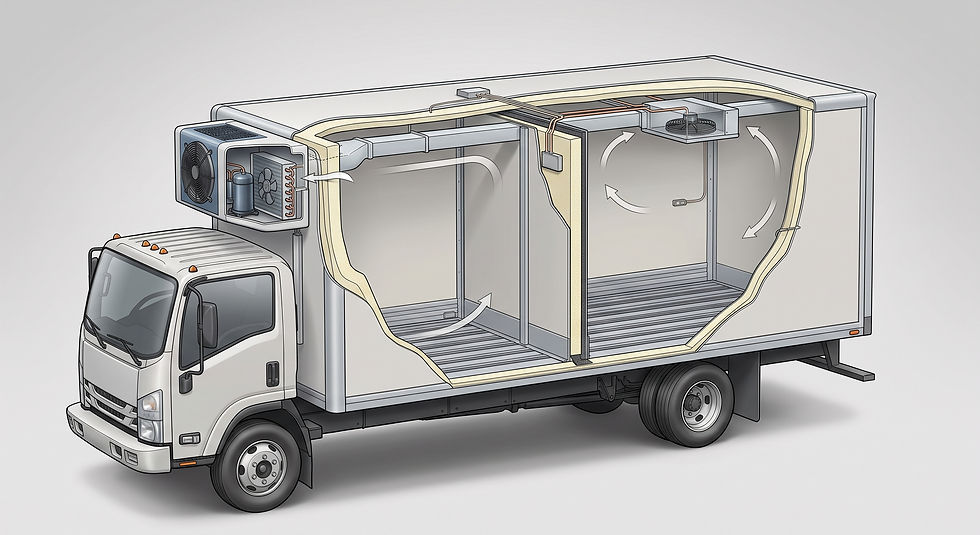
1. A clearer definition of “Equipment” — The definition of equipment is revised to describe it as an assembly comprising the insulated body and the supporting structure required for road or rail carriage. Where a thermal appliance is fitted, it forms part of that assembly. This clarification is relevant when defining the technical configuration that forms the basis of ATP conformity.
2. Provisional ATP certificates are explicitly limited to six months — Annex 1, Appendix 1 clarifies that, where a provisional certificate is necessary, its maximum validity is six months. Organizations using temporary certification workflows should ensure that their internal processes and renewal planning reflect this limit.
3. Part-load airflow requirements are clarified — For mechanically refrigerated equipment, the wording concerning airflow after the set-point temperature has been reached is simplified. Air volume flow may be modulated during part-load operation and continuous airflow is not required. For equipment designers and test teams, this makes control strategy and airflow behaviour an important part of technical interpretation.
4. Multi-compartment and multi-temperature equipment are defined more precisely — The amended ATP text distinguishes multi-compartment equipment from multi-temperature equipment and introduces definitions for fixed, movable, longitudinal and transversal dividing walls. The associated test provisions are also clarified, including simultaneous testing of compartments and additional reversibility testing for applicable multi-temperature equipment.
5. Temperature recorder requirements are modernized — Annex 2, Appendix 1 introduces updated references to EN 12830:2018 and EN 13486:2023. Verification is to include at least two measurement points, with verification documentation made available to the relevant ATP competent authorities. The amended text also links the calibration of inspection measuring equipment to laboratories accredited in accordance with EN ISO/IEC 17025:2017. Transitional provisions allow temperature recorders already in service that comply with EN 12830:1999 to continue to be used.
The 2026 changes should be treated as configuration and evidence-management changes—not merely as wording updates.
Why the ATP Handbook matters
The ATP Handbook combines the Agreement and its Annexes with explanatory comments. UNECE notes that these comments are not legally binding on Contracting Parties, but they are important for interpretation, harmonization and application because they reflect the opinion of WP.11. For technical teams, the Handbook is therefore a useful interpretation aid, but it should not be confused with an independent approval or certification source.
The ATP Handbook is a valuable interpretation aid, but its comments are not legally binding requirements.
What happens next?
The next scheduled WP.11 session is the 83rd session, to be held in Geneva from 27 to 30 October 2026. The agenda and working documents around that session will be important for understanding which ATP topics are moving next and where future technical changes may emerge.
ATP Compliance perspective
The most effective way to respond to an ATP amendment is to treat it as a controlled engineering change. Identify the changed requirement, determine the affected equipment or process, evaluate the evidence currently used to demonstrate conformity or performance, and update only what is technically necessary. This approach avoids both under-reaction and unnecessary rework.
The most efficient response to an ATP amendment is controlled change: identify what changed, assess what it affects and update only what is technically necessary.
Sources
Primary reference: UNECE ATP Handbook incorporating amendments entering into force on 25 August 2026. Related follow-up: UNECE WP.11 83rd session, 27–30 October 2026, Geneva.
ATP Compliance is an independent technical information and advisory platform and is not affiliated with UNECE, national competent authorities or official ATP test stations.
Related Technical Guides
Need technical guidance?
ATP Compliance provides independent engineering guidance on ATP requirements, testing strategy, measurement quality and compliance readiness.
Comments